Every metric tells you a different piece of a token's story. TVL, liquidity, volume, social, derivatives, each one is true, and each one is only a slice. Sometimes they may have contradicting narratives.
If you just want to know which projects deserve your attention right now, you were left making your best guess from these numbers, never quite sure you read them right.
So we built that one number that does it for you.
Introducing Signal, and from now on it is the only metric you need to read the market.
The Signal
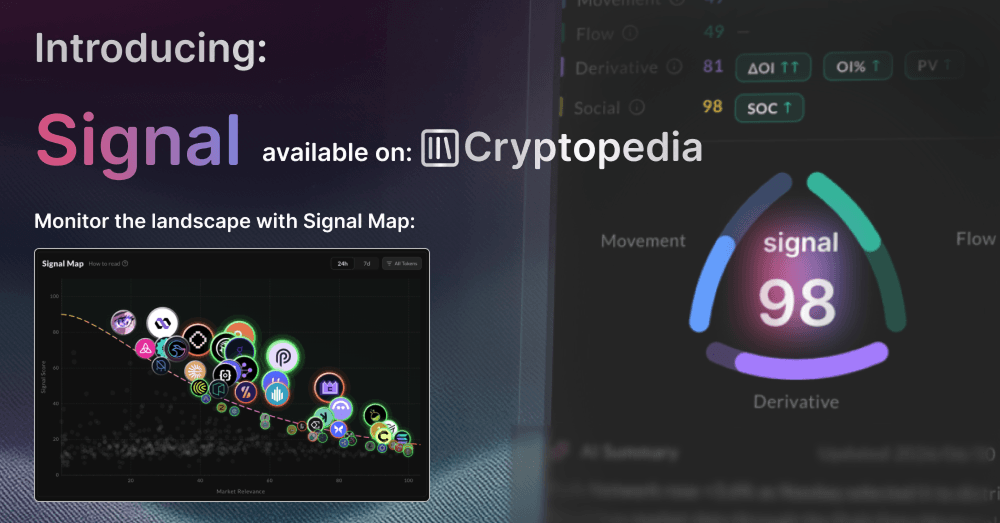
Signal's goal is to indicate you with which project is showing real signal worth giving attention to, and expresses it as a single number from 0–100. Price, trading flow, leverage, liquidations, funding, social attention, are all fused into computing Signal, so that single ordinary activity cannot pass for a real move and only Signals that are worthy of attention are signed off as real momentum.
Under the hood, it measures one thing: how far a token is deviating from its own normal behavior right now. Not how large it is, not how much volume it trades in absolute terms, but how abnormal its current activity is against its own recent history. A high Signal means a token is doing something it does not usually do.
Three things separate it from a trending list:
- Token-relative. Every input is scored against the token's own baseline. A 5 percent hour is normal for a memecoin and extraordinary for BTC.
- Multi-dimensional. One score fuses price, flow, derivatives, and social, instead of leaving you to reconcile four dashboards.
- Reproducible. Deterministic. The same inputs always produce the same score, and every score can be explained. No vibes.
Signal is not price or direction. A token can be down 18 percent and still rank among the hottest names, because the abnormality is in the activity underneath the move, not in the candle.
Core States: the why behind the number
A high Signal tells you something abnormal is happening. The Core State tells you what kind. This is the part no chart and no feed will give you.
With that, each state reads like a sentence on explaining why a token's Signal Score may be skyrocketing:
- Leverage Expansion. The crowd is piling into borrowed-money bets. Greed building, and fragile.
- Long Liquidation Pressure. The people betting up are getting flushed out right now. Usually a painful drop in progress.
- Liquidation Spike. A sudden burst of those force-closes at once. A flush just happened.
- Crowded Shorts. Too many people betting down. If price ticks up they all have to buy back fast, which launches it. The classic squeeze setup.
- Short Leverage Build-Up. Down bets stacking up. A bearish crowd forming before it gets extreme.
- Social Attention Spike. People suddenly talking about it, before price has moved. Attention arriving ahead of the action.
- Low Liquidity Move Down. Price dropped on almost no real trading. A crash in an empty room. Easy to reverse, easy to fake.
- Mixed Anomaly. Several odd signals at once with no clean pattern. Something is off but it does not fit a label.
Read together, Signal tells you a token is breaking from its pattern, the Core State tells you why, and the two of them tell you whether the move is real.
Reading the Signal Map
Signal is now the spine of Cryptopedia. You scan the live market by what is measurably unusual, not by who paid for attention this week.
Token of the Day, Token of the Week. The single highest-Signal name for the day, and for the week, surfaced with its Core State and a one-line explanation of why it stands out. It is not just the top score. It blends the Signal, how relevant and tradable the token is, how clean the pattern is, and how abnormal the social attention around it is, so the name you land on is the one with a real story, not just the loudest number. This is the fastest answer to "what is the story today?"
The Signal Map. A bubble chart of the whole tracked market. A token's position left to right is its market relevance, niche names on the left, blue chips on the right. Its height is its Signal, the higher up, the more abnormal. A dashed line runs across the map, the minimum Signal a token needs to stand out given its relevance: above it is the breakout zone, near it is the watchlist, below it is normal range. Bubble size shows how unusual the token is for its relevance, and the glow shows direction, green climbing, red bleeding. One glance tells you what is breaking out, and whether it is a major or a long-tail token. Click any bubble for its per-dimension breakdown, its Core State, and an AI summary.
Signal Rankings. The same market as a leaderboard. The Signal scores, the Core State and its driver, price and moves across 1h, 24h and 7d, a week-long sparkline, market cap, volume, and open interest. Sort it however you read, or filter to a single exchange and you only see what you can actually trade where you trade it: All, Binance, Binance Alpha, Bithumb, Upbit, Bybit, and the rest.
How to use it to catch alpha
Tell a real move from a fake one. A token pumping with a Low Liquidity Move state, or with nothing but a Social Attention Spike and no on-chain driver behind it, is exactly the kind of pump that evaporates. Signal labels it so you do not chase the exit liquidity.
Catch attention before price. A Social Attention Spike on a token whose price has not moved yet is the market noticing before the candle does. That window is where the early entries live.
Hunt the squeeze. Crowded Shorts means the market is leaning hard one way, and that lean is fuel. A small move against the crowd can turn into a violent reversal, and you can be there before it fires.
Manage your risk. If something you hold flips into Long Liquidation Pressure or a Liquidation Spike, you are being told a cascade is live. That is your cue to tighten, not to look away.
Cut the noise. The live market is hundreds of names trading at once, almost all of them quiet. Signal ranks them by what is worth your attention, so your time goes to the handful where something real is actually happening.
The shift
Price tells you what already happened. Social tells you who is shouting. Signal tells you what is genuinely breaking from the norm, why, and whether to trust it, the only version of the story you can act on before everyone else does.
The renovated Cryptopedia is live. Find what is actually moving, before the rest of the market does.